5 Best Ferns for Your Pocket Terrarium (And How Not to Kill Them)
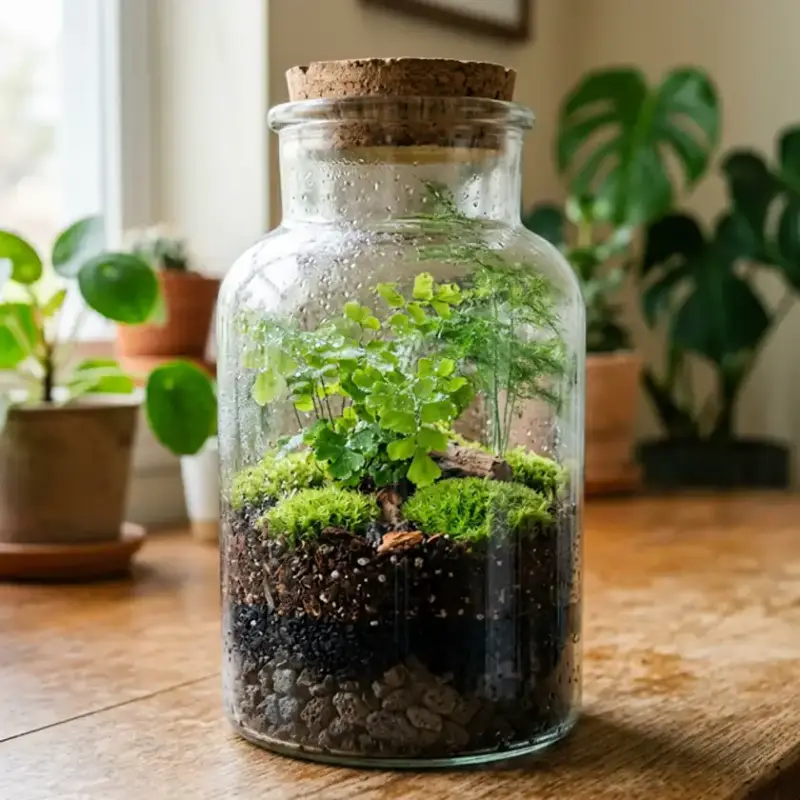
The Unforgiving Paradox of Terrarium Ferns
Beyond the Aesthetic: Why Your Terrarium is a Death Trap
Here is a cynical truth. The overwhelming majority of the “aesthetic” terrariums you see scrolling through your social media feeds are ecological death traps. They’re hastily built by superficial influencers who care vastly more about symmetrical dirt layers and brightly painted ceramic mushrooms than the actual biological reality of the organisms slowly suffocating inside the glass.
They are building colorful graves.
If you want to build a pocket terrarium that survives past its first photo shoot—and matures into a deeply calming, restorative piece of living art—you need to understand the unforgiving paradox of terrarium ferns.
They possess an absolute, non-negotiable requirement for high ambient humidity (ideally stabilized between 60% and 80%). But they exhibit a fatal, rapid intolerance for waterlogged root systems. In horticulture, we call this “wet feet.” In your living room, it’s just a rotting pile of expensive compost.
Ferns are the unquestioned standard companion for indoor moss in any miniature arrangement. They provide structural architecture. Striking texture. An ancient, primeval energy that anchors the entire design. But keeping them alive in a sealed jar requires a highly pragmatic approach to substrate engineering and a ruthless commitment to maintenance.
Stop trying to force delicate plants into terrible environments. Instead, build an environment that forces them to thrive.
If you are genuinely serious about curating thriving closed terrarium plants that embody the profound principles of seijaku (energized calm) rather than chaotic decay, here are the best ferns for terrariums—and exactly what you need to do to keep them from turning into black mush.
Fern Biology 101: The Emersed Illusion
Before you touch pruning shears or buy a bag of soil, you must understand what you are actually purchasing when you pick up a tiny fern at the local nursery.
Ferns are ancient. They reproduce via microscopic spores, not modern seeds or flowers. Structurally, the ferns we use for miniature landscaping expand outward through a creeping rhizome—a thickened, highly sensitive horizontal stem sitting just below (or right on top of) the soil surface.
But here is the fatal catch: the vast majority of commercially available ferns are cultivated “emersed.” They are grown with roots in saturated soil but foliage in open air. Their broad, tough leaves are hopelessly inefficient as high humidity indoor plants when sealed inside the stagnant, hyper-humid microclimate of a pocket terrarium. The plant experiences violent environmental shock.
What happens next terrifies beginners. The plant triggers autolysis. It intentionally sheds its obsolete emersed leaves to redirect energy into new fronds optimized for high-humidity. This is the concept of mono no aware in action—the sad, necessary passing of the old to make way for the new.
Absolute Warning: Do not panic. Do not immediately flood the soil with water assuming it is dry. Let the plant adapt.
The Top 5 Terrarium Fern Species
Curating plants for a closed system must be an exercise in extreme precision. Out of the tens of thousands of fern species on earth, only a tiny fraction possess the compact growth habits required for survival in small containers.
1. The Lemon Button Fern (Nephrolepis cordifolia ‘Duffii’)
This is a pragmatic, nearly bulletproof foundational plant for any beginner. Its compact, upright growth habit prevents it from aggressively overrunning your carpeting moss and choking out neighboring plants. It exhibits a much higher tolerance for occasional lapses in your watering schedule than its temperamental cousins. If you are searching for reliable small ferns for containers, start here.
2. The Maidenhair Fern (Adiantum)
Widely considered the crown jewel of indoor plants, the Maidenhair Fern is notoriously unforgiving. The dry air of modern HVAC systems instantly desiccates its tissue-paper-thin leaflets. Placing an Adiantum inside a closed terrarium solves this—the trapped moisture is exactly what its delicate biology craves.
However, proper Maidenhair fern care terrarium maintenance requires extreme vigilance regarding stagnant air and rotting soil. You must use a fine-mist sprayer to maintain atmospheric moisture without turning the substrate into a suffocating swamp.
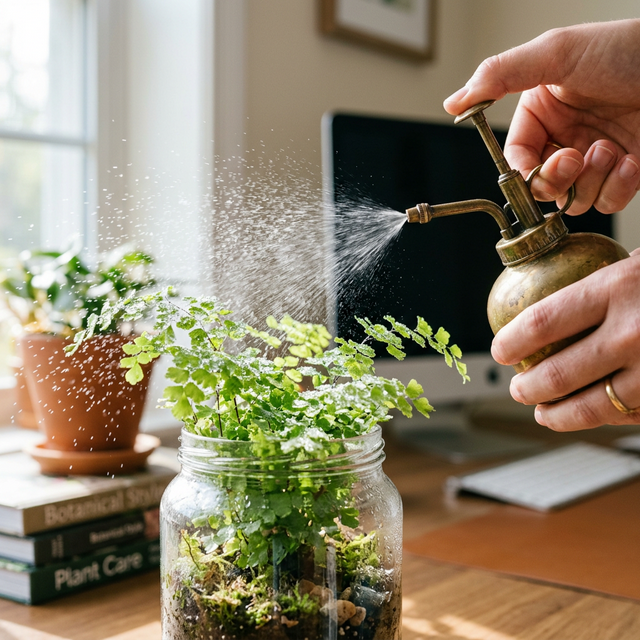
Proper misting techniques ensure high atmospheric humidity without saturating the delicate Maidenhair fern roots.
Pro Tip: If the Maidenhair begins to exhibit severe browning during its initial acclimatization phase, execute a hard prune. Cut the dying fronds entirely back to the soil level. This aggressive, necessary reset will trigger uniform, vibrant new growth.
3. The Asparagus Fern (Asparagus setaceus)
The Asparagus Fern is not a true fern, but its utility is unmatched. Its horizontally tiered, feathery foliage perfectly mimics the aesthetic of ancient ferns. Its true strategic value lies in architectural verticality. When designing a scene, you desperately need a canopy layer to draw the eye upward. The Asparagus fern acts as an ideal surrogate tree, providing height without casting dense, impenetrable shadows that suffocate mosses below.
4. The Crispy Wave Fern (Asplenium nidus)
Want something that commands immediate attention? The Crispy Wave offers a striking, aggressive architectural contrast. A modern cultivar of the Bird’s Nest Fern, it produces stiff, undulating, waxy fronds emerging from a tight central rosette.
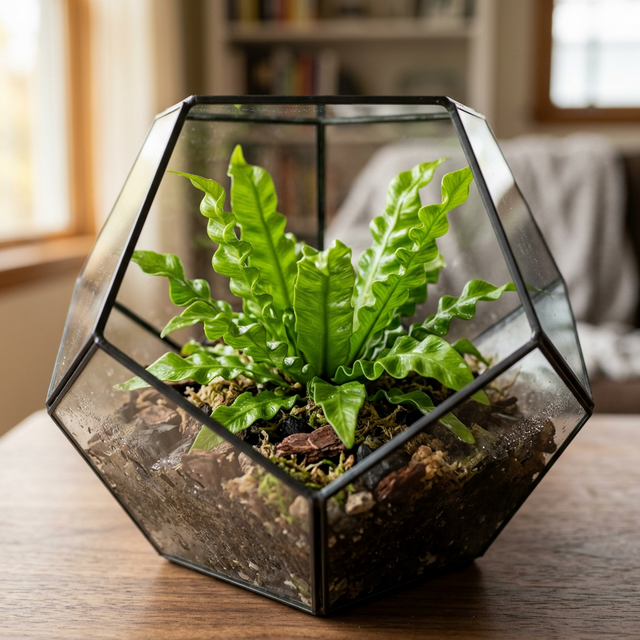
The Crispy Wave Fern provides a dramatic, architectural focal point for larger glass vessels.
Warning: Never pour water directly into the center of the Crispy Wave’s rosette. Stagnant water pooling in the crown will rapidly induce lethal bacterial rot. Always water the soil directly around the base.
5. The Button Fern (Pellaea rotundifolia)
Distinct from the Lemon Button, the New Zealand Button Fern features dark, leathery leaflets cascading along low-lying stems. This species has a horizontal, creeping growth pattern. It doesn’t reach for the sky; it humbly hugs the earth. Use it primarily as a dense, highly textural mid-ground transition between flat mosses and towering vertical elements. It perfectly embodies the Japanese concept of shibui—understated, fundamentally necessary to the structural balance.
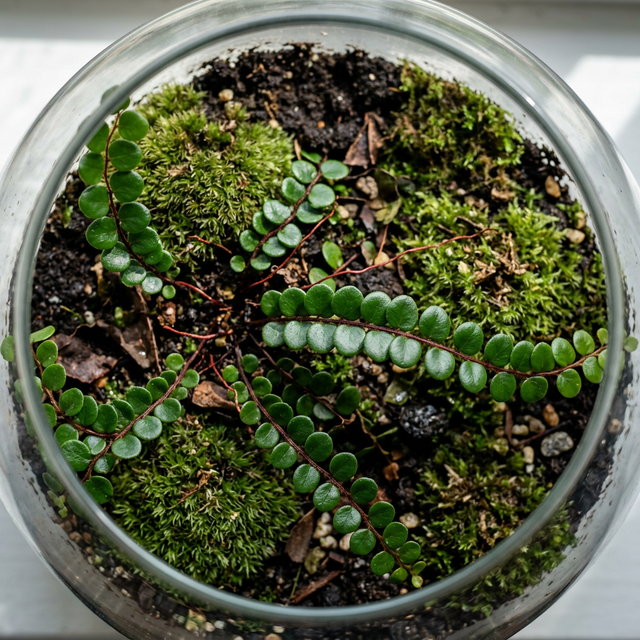
The low-profile Button Fern is an ideal choice for mid-ground transitions in a miniature landscape.
Substrate Engineering: The Architecture of Survival
The single most decisive factor dictating the lifespan of your miniature fern isn’t ambient humidity—it is the precise mechanical engineering of the subterranean environment. If you use generic commercial potting soil, you are actively dooming your plants.
Proper miniature fern soil layers must be constructed sequentially to ensure water flows rapidly past the root zone.
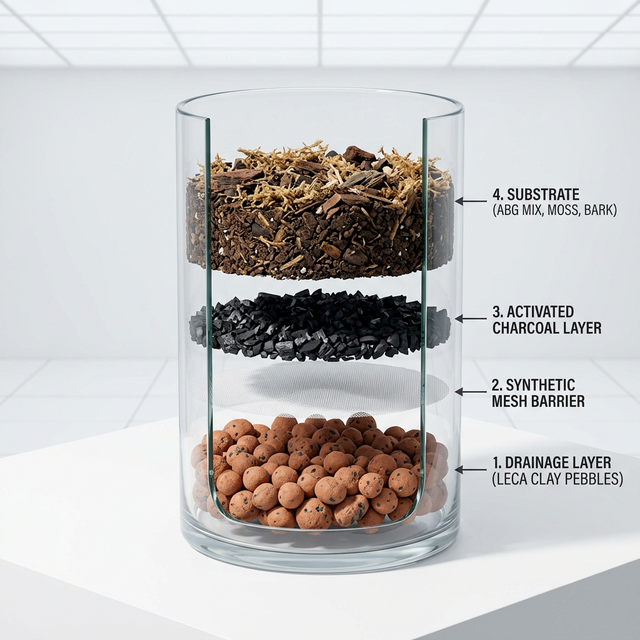
A multi-layered substrate strategy is the foundation of long-term terrarium health.
| Layer | Component | Function |
|---|---|---|
| 1. Drainage Base | 1-2 inches of LECA or lava rock. | Creates an artificial aquifer to hold excess standing water away from roots. |
| 2. Physical Barrier | Synthetic mesh or coffee filter. | Prevents fine soil particulates from migrating down and clogging drainage. |
| 3. Chemical Filtration | Horticultural activated charcoal. | Passively absorbs toxic gases and inhibits anaerobic bacteria. |
| 4. Substrate Matrix | ABG Mix variation (coco coir/bark base). | Provides a highly aerated, compaction-resistant growing medium. |
Preventing “Fern Melt” and Managing Rot
“Fern melt” is characterized by the sudden, catastrophic liquefaction of a fern’s foliage. While the initial physiological shock of leaf shedding is normal, total melting means you have suffocated the rhizome.
Novices have a habit of burying ferns deep into the soil. This is a fatal error. The rhizome is the biological command center. Deprived of oxygen in a damp environment, it immediately begins to rot.
If you want to understand how to stop terrarium fern melt before it even begins, employ a delayed acclimatization technique. Rather than immediately uprooting a newly purchased fern, place the plant—still in its nursery pot—directly inside the terrarium and lightly close the lid for two weeks. Allow the delicate foliage to gradually adjust to the microclimate before you inflict root trauma.
Absolute Warning: Plant your ferns incredibly shallowly. The top half of the rhizome must remain entirely exposed to the ambient air circulating within the terrarium.
Pruning Protocols and Airflow Management
A closed terrarium is an active, evolving biological engine, not a static, dead museum piece. You must prune proactively and mercilessly. Embrace the imperfection of wabi-sabi, but do not tolerate rotting waste.
When an older frond inevitably senesces, excise it immediately. Use sharp, sterilized micro-shears. Trace the dying frond down to its origin point near the soil line and sever it cleanly.
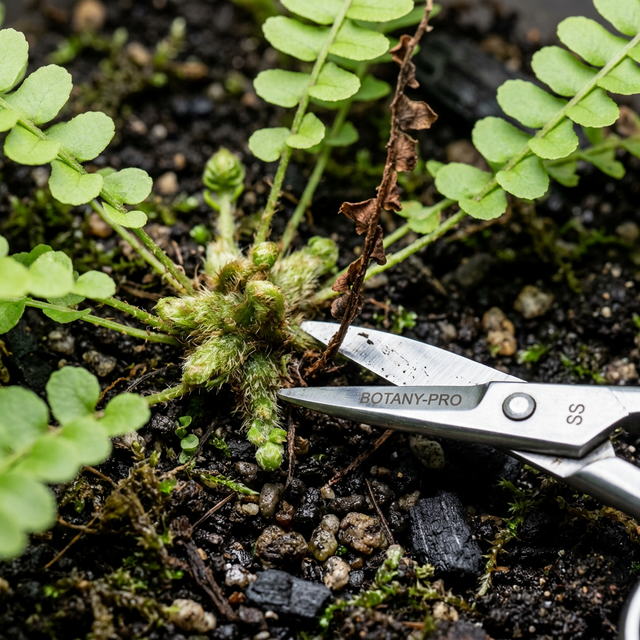
Proactive pruning maintains the intended scale and prevents the decay of older foliage.
For aggressive growers, proper asparagus fern pruning terrarium maintenance requires routine structural thinning. This preserves the illusion of negative space (Ma), reduces visual noise, and ensures light penetration reach the lower levels.
Lighting Needs: The Photobiology of Microclimates
The optimal lighting environment for a pocket terrarium is bright, indirect light. Placing a sealed glass vessel in direct, unfiltered sunlight is a catastrophic amateur error. The glass acts like a magnifying lens, capturing solar radiation and literally cooking your delicate ferns and mosses to death.
To achieve consistent, safe lighting, keep the terrarium several feet away from a bright window. Utilize specialized LED grow lights for a controlled, full-spectrum light source without the dangerous thermal heat.