Dry River Technique: Creating Flow Without Water
As an Amazon Associate I earn from qualifying purchases.
Fifty-eight percent of the American West is currently baking in drought, yet the obsession with backyard babbling brooks persists. Building a water feature in an arid climate is an expensive, irresponsible liability. If you want the visual peace of water without the swampy, mosquito-ridden reality, you need to master dry river bed landscaping.
DeWitt Pro 5 Heavy-Duty Landscape Fabric
Check Current Price on AmazonI’m not talking about dumping three bags of cheap hardware-store pebbles into a ditch and calling it a day. That looks like a construction site. The Japanese karesansui (dry mountain water) approach is a precise, brutal horticultural technique. It relies on geomorphic grading and exact stone orientation to mimic relentless water energy—without a single drop of actual moisture. It works.
It works.
The Philosophy Behind the Flow
Stop trying to literally recreate nature. It’s tacky. A real dry river demands an understanding of karesansui water symbolism, tracing its lineage from temple to tabletop. It’s rooted in the Zen concept of ma—negative space. As we explore in our guide to mastering ma in Zen garden design, ma dictates that the empty stretches of raked gravel aren’t just filler between rocks. They are the design. They give your eyes room to breathe.
Look at the Daisen-in temple. The gravel river isn’t a static decoration; it’s a metaphorical journey. It starts as a jagged, dry waterfall in the mountains, crashes through rapids, and empties into a silent sea of raked white sand. It’s shibui—understated, quiet, boring beauty. Get this right, and you elevate a yard from a mere drainage ditch into high art. Get it wrong, and it’s just a pile of rocks.
Building the Foundation: Sub-Surface Mechanics
Let’s get pragmatic. Your poetic metaphor sits on the earth, and the earth demands cold, hard engineering. I see it all the time. An amateur tries to build a DIY dry creek bed for drainage and it fails miserably within twelve months. Why? They ignore the sub-surface mechanics. The stones sink into the mud. Aggressive weeds choke the gravel. Suddenly, your serene retreat is a muddy maintenance nightmare, requiring resilient climate-adaptive engineering.
If this thing is going to actually manage seasonal runoff, you follow a rigid sequence:
- Excavation: Dig a gently sloping, bowl-shaped trench. To prevent the banks from collapsing, use a 2:1 width-to-depth ratio. For example, if your river is 3 feet wide, the very center should be exactly 1.5 feet deep. Think of it like a shallow, elongated saucer, not a steep ditch.
- Fabric Foundation: Do not skip this. Put down heavy-duty, non-woven geotextile fabric (DeWitt Pro 5 (paid link) or similar). This stops the earth from swallowing your expensive stones. It’s a ruthless weed barrier. But it still lets water drain.
- The Base Layer: You need a 1-inch layer of crushed pea gravel over the fabric. This gives you void spaces for temporary water collection.
- Slope: You need a minimum 1% grade to move water. If your slope is steep—over 15%—you have to use massive anchor stones or the whole bed will wash out during the first severe storm.
Crucial Note: A dry river is only as calm as the trench holding it.
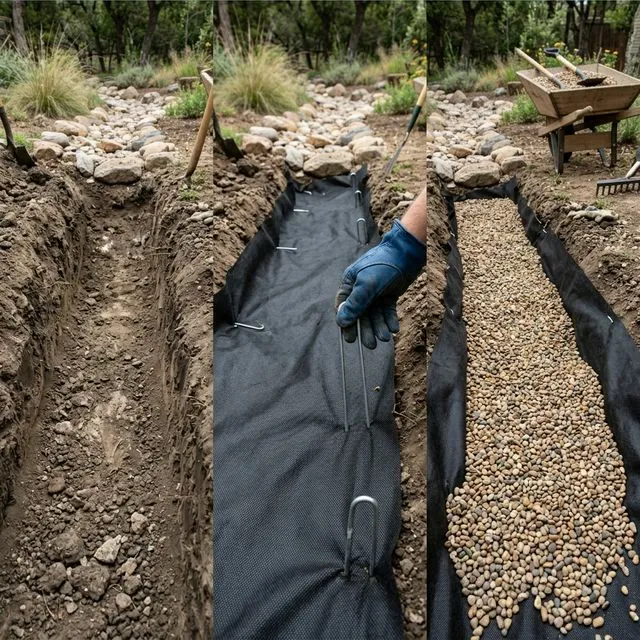
Infrastructure: Excavation and heavy-duty landscape fabric are the foundation of any functional dry creek bed.
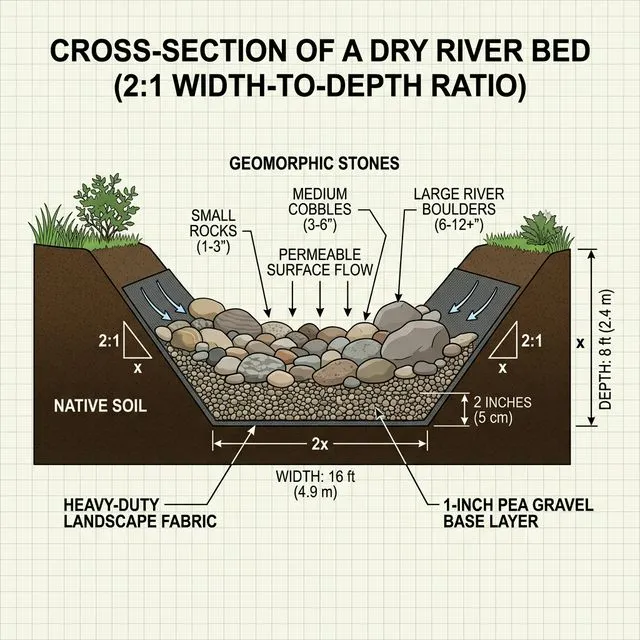
Engineering: A technical cross-section showing the required layers and width-to-depth ratios.
Geomorphic Grading: Mimicking Natural Currents
The most offensive mistake in amateur gravel river design? The polka-dot effect. Spreading uniformly sized, perfectly round rocks evenly across a ditch. Nature doesn’t do that.
Real rivers sort sediment by kinetic energy. Fast currents strip sand and leave boulders. Slow water drops silt. To pull off creating flow with stones, you must mimic this grading with at least four distinct sizes.
| Stone Classification | Size Range | Natural Proxy | Design Function |
|---|---|---|---|
| Boulders / Anchor Stones | 12 – 36 inches | Eroded bedrock | Defining the banks and breaking the energy. |
| Medium Cobbles | 4 – 10 inches | High-energy channel rocks | Creating the main channel boundary. |
| River Rocks | 1 – 4 inches | Standard bed load | Simulating the primary flow. |
| Pea Gravel / Sand | 0.125 – 0.5 inches | Slow-moving deposits | Filling gaps and providing the base for raking. |
Warning: A 36-inch boulder can easily exceed 1,100 lbs. Unless you are renting heavy machinery (like a skid steer), limit your anchor stones to the 12-16 inch range (roughly 65-110 lbs), which can be moved with a heavy-duty hand truck (paid link) and two people.
Here is an unpopular opinion: perfect symmetry ruins stone placement. When placing anchor stones, cluster them strictly in odd numbers—groups of three, five, or seven. And bury the bottom third of the boulder. It should look like it’s emerging from the earth, heavily weathered, not resting on top like a paperweight.
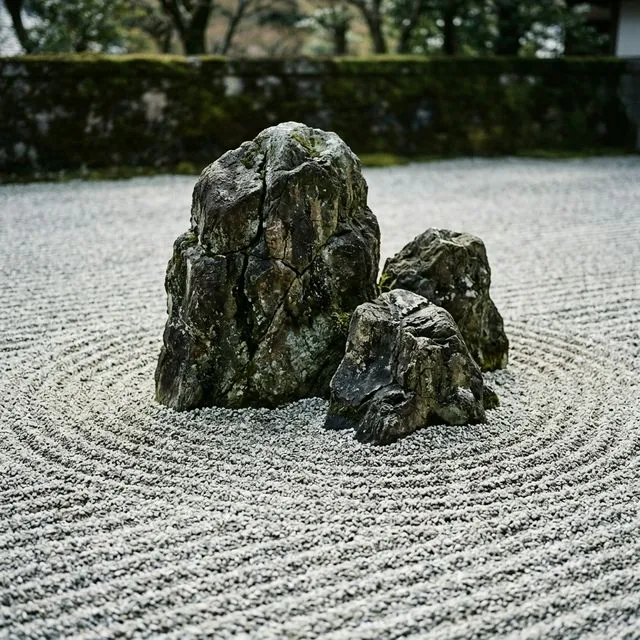
Fluidity: An island rock grouping with concentric Mizumon raking patterns mimicking ripples in water.
Stone Orientation: Directing the Eye and the Energy
Size is half the battle. The physical orientation dictates the perceived velocity. Every stone has a “face”—the textured side—and an implied direction.
If you are actually serious about creating flow with stones, you lean the rocks in the center of the stream slightly toward the source. Uphill. This mimics how rushing water tilts heavy objects against the current over centuries.
Manage the energy at your curves. Water hits the outside of a bend with maximum force. So, put your largest, most aggressive boulders on the outside of the curve. The inside of the bend naturally slows down—fill it with fine pea gravel to represent a tranquil sediment beach.
Follow the “Hidden Stone Logic.” Don’t let the viewer see the whole composition from one spot. Force them to walk. Make them discover the flow as it vanishes behind a mound of moss, introducing the mystery of yūgen to your design.
The Art of Samonbiki: Sculpting the Waves
The defining visual of a dry space is raked lines representing fluid dynamics. This is the ritual of samonbiki.
Let me be entirely clear. A standard metal garden rake from the hardware store is useless here. It just scratches the surface. To get the deep, sharply defined, shadow-casting grooves needed for authentic raking patterns for water, you need the right tools. Searching for Zen garden raking tools Amazon (paid link) will often yield flimsy toys. Look specifically for a commercial-grade, wide-toothed wooden landscaping rake (often sold as a ‘lake rake’ or ‘samonbiki’) with dowel teeth set 2 to 4 inches apart. If you can’t find one, build your own using a hardwood 2x4 and thick wooden dowels. You pull it with your entire body weight. Not your wrists.
The pattern changes the spirit of the space:
- Mizumon: Concentric circles radiating around anchor stones. The expanding ripples of a dropped pebble.
- Ryūsui-mon: Parallel lines that weave and cross to mimic turbulent, high-energy currents and rapids.
- Chokusen-mon: Unbroken, perfectly straight parallel lines creating a minimalist plain. Deep winter stillness.
Pro Tip: Raking isn’t a one-and-done event. Wind, rain, and wandering raccoons will ruin your lines. Refreshing the patterns weekly is a mental reset. Not a chore.
Edge Planting: Softening the Banks
A dry river surrounded by bare dirt looks like an abandoned construction site. You need to soften the banks with intelligent horticulture, adhering to wabi-sabi—the beauty found in imperfection and weathering.
Pick plants that can survive the harsh reality of a baking stone bed. While Hakonechloa macra (Japanese Forest Grass) offers the perfect visual cascade over granite, it requires shaded moisture. In full sun, substitute it with true drought survivors like Blue Fescue (Festuca glauca) or hardy ornamental sedges.
Anchor sharp bends with dwarf garden junipers. Use creeping thyme to bleed organically into the gravel edges. If you have the space, plant a single Japanese Maple (Acer palmatum) near the headwaters, adhering to the principles of growing Japanese maples in pots if dealing with a restricted space like a balcony tsuboniwa. The fleeting autumn foliage expresses mono no aware—a melancholic appreciation for the passing of seasons—contrasting sharply with the eternal rock below.
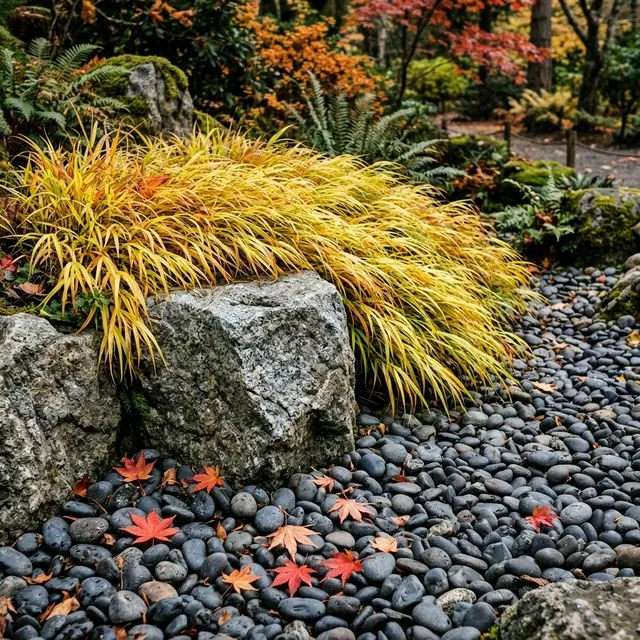
Seasonal Contrast: Edge planting with Japanese forest grass provides a soft, organic contrast to the eternal stone bed.
Commercial-Grade Wooden Landscape Rake
Check Current Price on AmazonThe dry river bed solves a modern nightmare. It fixes residential drainage and drought. It asks you to look at a massive pile of gravel and see an ocean of silence. Stop treating your yard like a battleground of chemicals and roaring lawnmowers. Do the brutal heavy lifting for geomorphic grading. Lay the commercial-grade fabric. Rake the samonbiki patterns with absolute intent. Strip away the chaotic visual noise. Pick up the shovel. Get to work.