Floating Islands: The End of the Hanging Moss Ball Lie
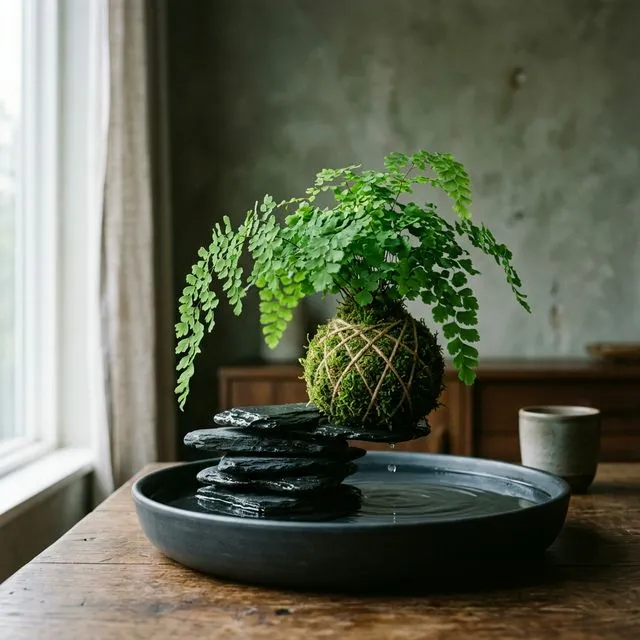
Stop hanging your plants. Seriously, just stop it. Traditional hanging Kokedama and string gardens are a death sentence in a modern home. Your HVAC system is a moisture-sucking vampire, and your string garden is its favorite snack.
If you want a display that actually survives—one that offers genuine Seijaku (that energized calm we’re all chasing)—you need to ground your plants. We’re building a Floating Island instead. No more “botanical gulags” of plastic pots or high-maintenance hanging nightmares. We’re using slate risers and a shallow basin to create a self-regulating microclimate. It’s part horticulture, part engineering, and entirely devoid of corporate “mindfulness” fluff.
1. Why Your String Garden is a Dehydrated Scab
The Western obsession with “string gardens” is aesthetic over-function at its worst. We treat the modern Kokedama presentation as a shortcut to Zen without actually understanding how a plant breathes.
You buy the kit. You wrap the roots. You hang it from a hook. And for exactly forty-eight hours, you feel like a master gardener. Then, the indoor desiccation hits. Because that moss ball is exposed to air on all sides, it dries out with brutal efficiency. Within a week, that vibrant green moss is a brown scab. Your “creative plant display” looks like a discarded clump of dryer lint—or worse, a very expensive mistake.
To save it, you’re told to “dunk and squeeze.” It’s messy, it’s inconsistent, and it’s a logistical nightmare. You end up with water spots on your hardwood and a plant that is perpetually stressed by the boom-and-bust cycle of moisture.
Stop trying to force a forest-floor organism to live like a kite. It’s time to look at how this art form actually started.
2. Edo-Era Pragmatism vs. Modern Fluff
If you want to build something that lasts, respect the lineage. Kokedama isn’t a “trend”; it’s a pragmatic evolution of Japanese horticultural practices dating back to the Edo era (around 1600 AD). They used to call it the “poor man’s bonsai.”
While the elite were obsessing over expensive ceramic pots, the common folk were practicing Nearai. They’d grow a plant in a pot until the root system was so dense it held the soil together. Then they’d pop it out and place it on a tray. The roots were exposed, celebrated for their gnarled, weathered beauty—a perfect expression of the authenticity of Wabi-Sabi.
The Floating Island we’re building today returns to these grounded roots. By placing the moss ball on a Kokedama watering tray—a stone plinth within a water basin—we’re honoring the original intent. We aren’t trying to make the plant “float” in the air; we’re creating a miniature scene where the plant exists in a state of Hydroponic wabi-sabi.
This isn’t about “looking Japanese.” It’s about the Shibui principle of understated, functional beauty. A stone, a dish, a ball of moss. No plastic, no pumps, no nonsense.
3. The Desert in Your Living Room
Let’s talk about the biology you’re ignoring. Most Kokedama plants evolved in high-humidity environments. Your home? Ambient humidity in a modern apartment often drops below 20%. For a moss ball, this is catastrophic.
The traditional hanging method maximizes surface area, allowing the exterior moss to act as a massive wick that dumps internal moisture into the thirsty air—the primary cause of “plant fatigue.”
Also—and I can’t stress this enough—the “dunk and soak” method is an amateur’s solution. It leads to anaerobic pockets in the soil, root rot, and the eventual collapse of the Kokedama structure. You’re literally drowning the plant one day and dehydrating it the next. It’s a botanical rollercoaster that no living thing enjoys. If you want Indoor Kokedama care that doesn’t feel like a second job, you need a system that manages humidity passively.
4. The Architecture of the Floating Island
The “Floating Island” is the definitive cure for the desiccated moss ball. The architecture is simple: a shallow ceramic basin, a few pieces of natural slate, and the Kokedama itself.
In this water-based Kokedama display, the moss ball doesn’t sit directly in the water. That’s how you get rot. Instead, it sits atop slate risers (plinths) that keep the base of the ball just a fraction of an inch above the water line.
This creates a water feature with moss balls that functions as a high-performance Indoor humidity tray for plants. As the water in the basin evaporates, it creates a localized microclimate—a bubble of high humidity trapped around the moss ball. The plant isn’t fighting the room’s dry air; it’s living in its own private oasis.
It is a Floating island garden DIY project that actually works because it respects physics rather than home decor trends. You get the visual tranquility of a water feature without the tacky hum of a plastic pump or the maintenance of a filter.
5. VPD: The Only Metric That Actually Matters
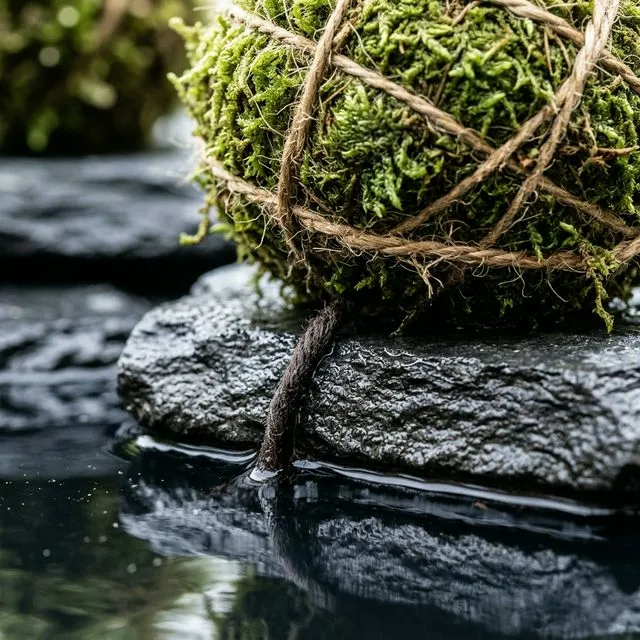
VPD Management: Capillary wicks and water basins provide the consistent hydration string gardens lack.
Listen to me: if you don’t understand Vapor Pressure Deficit (VPD), you’re just guessing. VPD is the difference between the amount of moisture in the air and how much moisture that air can hold when saturated. A high VPD means the air is “thirsty” and will rip moisture out of your plant’s leaves and soil.
By using an Indoor humidity tray for plants (the basin), you are lowering the VPD in the immediate vicinity of the Kokedama. But we can go further. For the truly committed—the ones who actually want their plants to live past next month—we use a hidden capillary wick. A strip of terra tape or unbleached nylon cord embedded in the soil core that extends down through the slate risers into the water.
This creates a passive, self-watering system. Through capillary action, the wick pulls exactly as much water as the soil needs to stay moist, but never sodden. It is the ultimate expression of Hydroponic wabi-sabi. The plant takes what it needs, and you stop worrying about whether you “dunked” it enough this week.
6. Sourcing the Materials: The Shibui Palette
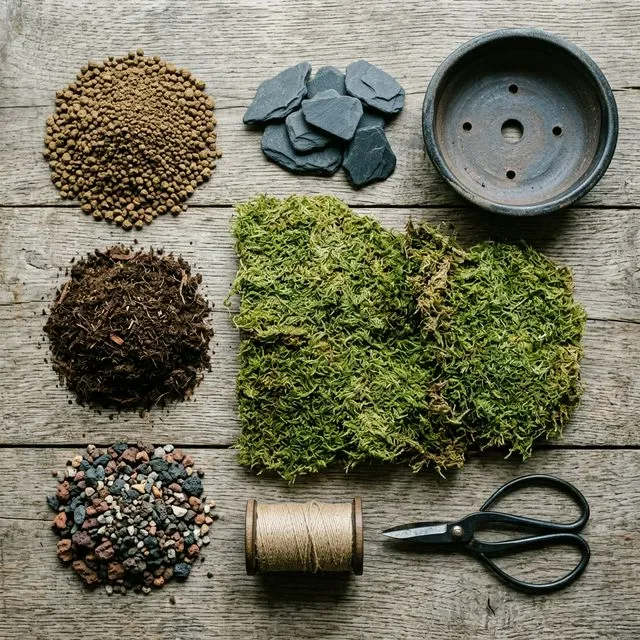
The Shibui Palette: Raw slate and volcanic Akadama provide the structural integrity required for Nearai-inspired displays.
Don’t go to a big-box store and buy “premium potting soil.” That stuff is garbage. It lacks the structural integrity to hold a shape and the minerals to support long-term moss health.
To build a real sanctuary, you need the Shibui palette:
- Keto Soil (or Peat Moss): The “glue.” You want a 70% Keto soil (or a sticky peat/clay mix) base to serve as the structural anchor. This provides the acidity moss loves.
- Akadama: Volcanic clay from Japan. Add Akadama for the remaining 30% to provide the granular drainage that prevents root rot.
- Natural Slate: Avoid polished stones. You want raw, jagged slate. It provides texture for the moss to “reach” for and looks authentic.
- Ceramic Basins: Unglazed or reactive-glaze only. Plastic is the antithesis of Zen. It feels cheap, it looks cheap, and it degrades.
- The Plants: Epiphytes or moisture-lovers only. Moisture-loving Staghorn ferns, Pothos, and Peperomia are ideal. They thrive in the high-humidity microclimate we’re creating.
This is about building a creative plant display that is also a functioning habitat.
7. Sculpting the Island (Getting Your Hands Dirty)
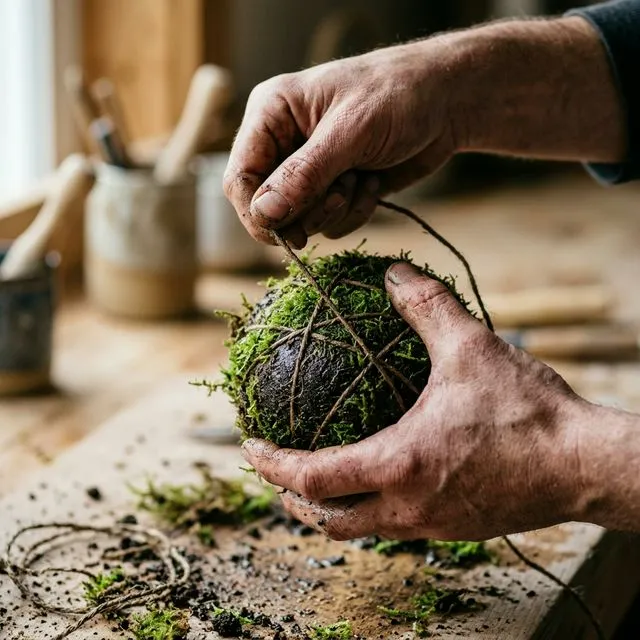
Construction Ritual: Building the "Island" is a somatic grounding exercise in biophilic engineering.
Clear your workspace. This is going to get messy.
- The Soil Matrix: Mix your Keto and Akadama. Add water slowly. You aren’t making mud; you’re making “dough.” It should be firm enough that you can form a grapefruit-sized ball and drop it from six inches onto a table without it shattering.
- The Core: Take your plant. Strip the plastic pot away and shake off the nursery soil. You want bare roots.
- Encapsulation: Split your clay ball in half. Place the roots in the center. Thread your capillary wick through the bottom. Close the ball. It should feel solid.
- The Moss Armor: Take your vibrant sheet moss (live is better, obviously). Wrap it around the clay.
- The Binding: Use natural-colored waxed twine. No neon nylon. Wrap it firmly but don’t strangle the roots. You’re creating a “net” until the moss takes hold.
- The Staging: Place your slate risers in the basin. Stack them to create a stable plinth. Seat your Kokedama on the slate.
- The Water: Fill the basin until the level is just a fraction of an inch below the moss ball.
Crucial Note: If the moss sits directly in the water for extended periods, it will rot and smell like a swamp. That gap is non-negotiable.
8. Ritualized Maintenance: Achieving Seijaku
Most people think “maintenance” is a chore. In the Floating Island system, it’s a ritual of Seijaku—an energized, focused calm.
Daily routine? Look at the water level. Low? Add more. That’s it. Passive evaporation does 90% of the work.
Once a month, give it a “deep soak” if the core feels light, but with the wick and the tray, you’ll rarely need to. Watch for algae; if it appears, you’re giving it too much sun or you need to wash the stones. For Indoor Kokedama care, use a liquid seaweed fertilizer once a quarter. Mix it into the basin water at half-strength.
Stop fussing over it. Part of the Zen aesthetic is allowing the plant to exist. If a leaf turns yellow? Let it. That is Mono no aware—the pathos of things. The beauty is in the change, not static perfection.
9. Ma: The Importance of Doing Nothing
Now that you’ve built your island, don’t ruin it by crowding it with trinkets. The most important concept in Japanese design is Ma—the essential negative space. It’s the pause between notes that makes the music.
Place your Floating Island where it can breathe. A single island on a clean console is more powerful than a “jungle” of cluttered pots. You want the eye drawn to the contrast—dark slate, shimmering water, vibrant moss.
This is a Modern Kokedama presentation. It should feel like a discovery, a piece of a mountain stream transported to your home. Use north-facing light for that soft, forest-floor glow. Direct sun will bake your island and turn it into a desert.
10. The Rebellion of the Floating Island
We live in an age of “biophilic design” where developers slap plastic ivy on a wall and call it a green building. It’s a cynical exploitation of our need for nature.
Building a water-based Kokedama display is an act of quiet rebellion. You’re choosing to understand the biological needs of a living thing and providing for them through architectural design. You’re moving beyond the “botanical gulag” of the plastic pot and into a space of genuine connection.
The Floating Island isn’t just a creative plant display. It’s a reminder of Mono no aware—that life is fleeting, and our job is to curate the conditions for its flourish.
Now, stop reading this and go find some slate. Your desk is waiting.