The Magic Carpet: How to Grow and Keep Moss Alive Indoors
The Inevitable Failure (The Problem)
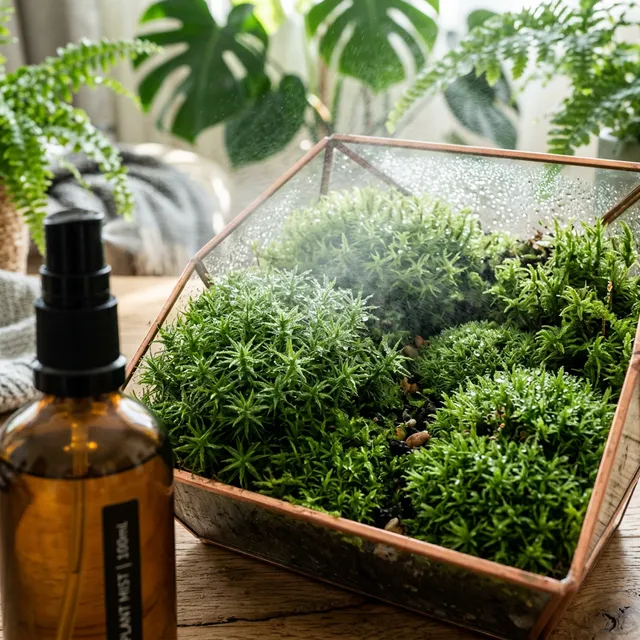
You see it constantly on social media. Someone drops serious cash on a beautiful, minimalist geometric glass terrarium. They carefully arrange a lush, emerald-green living carpet. It looks perfect.
A week later? The whole thing is a crunchy, brown, rotting mess. And they have absolutely no idea why.
The harsh reality about growing moss indoors is that people treat it like just another houseplant. It isn’t. Not even close. If you’ve been watering it from the tap, sticking it in regular potting soil, or putting it in a dark corner—stop. You have to unlearn almost everything you know about basic indoor horticulture right now. Consider this your definitive moss care guide. Let’s stop pretending and fix this.
The Biological Sabotage (The Agitation)
Moss is a bryophyte. It lacks the sophisticated internal plumbing of standard vascular houseplants completely.
Pro Tip: Moss doesn’t have roots. Stop burying it in heavily fertilized dirt.
Standard vascular houseplants (think your trusty Pothos or Monstera) have massive root networks. They pull moisture and nutrients up from the soil. Moss works entirely differently.
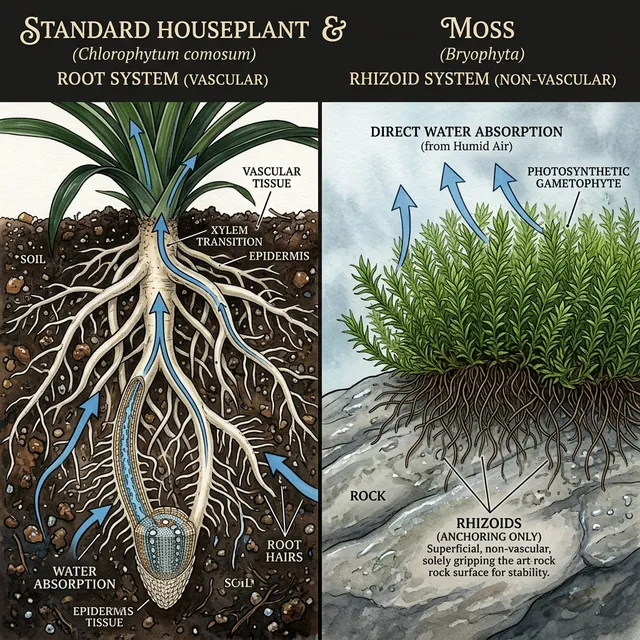
A comparative botanical illustration demonstrating the profound physiological difference between standard vascular houseplants (left) and the superficial, anchoring rhizoids of moss (right).
Look closely at the underside of a healthy moss colony. You won’t see thick, fleshy roots. You’ll see tiny, brown, hair-like threads called rhizoids. Their only job is gripping a rock or piece of bark so the plant doesn’t wash away in a rainstorm. They absorb exactly zero water or nutrients.
This lack of roots is why moss is what scientists call a poikilohydric organism. That’s a complicated word for a brutally simple concept: moss has absolutely no way to store water internally. It cannot actively pump water up from deep underground during a drought. Instead, its hydration level is permanently tied to whatever the air around it is doing. If the air is humid, the moss is plump, green, and actively photosynthesizing. The instant the relative humidity drops—like when your central heating kicks on in November—the moss immediately dries out and enters a defensive, dormant state. Understanding this single biological mechanism is the master key to keeping these ancient plants alive.
Moss drinks exclusively through its leaves. Every single drop of moisture it needs comes straight from the humid air around it or water settling on its surface. Sticking it in wet, heavy soil just suffocates the bottom layers, prevents critical gas exchange, and triggers a foul-smelling basal rot.
The Golden Rule: Water Quality
This is the non-negotiable part. You need distilled water for moss. Period.
| Water Source | Effect on Moss | Verdict |
|---|---|---|
| Municipal Tap Water | Chlorine burns the cell walls instantly; calcium creates a suffocating crust. Turns it brown and dead. | Absolute poison |
| Filtered Fridge Water | Still contains dissolved minerals that build up over time. | Too risky |
| Distilled / RO Water | Zero chemicals. Perfect hydration. | Mandatory |
| Clean Rainwater | Natural and ideal (if you don’t live next to a smoggy factory). | Excellent |
When you spray tap water on a normal houseplant, the soil acts as a barrier. The heavy dirt physically filters out and mitigates the impact of these harsh chemicals before they can severely shock the deep root system. But moss doesn’t have that luxury.
When you spray treated municipal tap water directly onto a patch of delicate moss, the harsh chemicals and heavy minerals accumulate instantly upon the surface of the plant tissue. Without any filter to protect it, the chlorine burns straight through the cell walls. You are essentially pouring mild bleach onto an extremely delicate organism. If your local water is hard, the dissolved calcium deposits create a suffocating, scaly mineral crust across the photosynthetic leaves, physically blocking the plant from absorbing light. Visually, this violent chemical reaction manifests as rapid, irreversible browning.
Stick to purified water for every single misting. Skip this one rule, and nothing else you do will save the plant.
Microclimate Mastery (The Solution)
You’ve got two options for a setup. One makes your life easy. The other is a constant, frustrating battle against dry indoor heating.
Want an open-air display or a desk accent? Be prepared to mist it aggressively, every single day. Modern homes have notoriously low humidity—often below 30%. In that dry air, moss enters survival mode, dehydrates, and turns incredibly brittle. (Check out The Ultimate Guide to Kokedama if you’re stubborn and want to try an open-air string garden anyway).
Sealed glass vessels are the ultimate hack for terrarium moss maintenance. They trap moisture and create a self-sustaining humid microclimate. But you still have to build it right:
- The False Bottom: Add expanded clay pebbles or coarse sand at the very bottom. This keeps the moss from sitting in standing water.
- The Filter: Add a generous layer of horticultural activated charcoal. It filters out toxins and stops the enclosed environment from smelling like a swamp.
- The Ventilation: Take the lid off for 15 minutes once a month. Stagnant air breeds fuzzy white mold. Give it a breather.
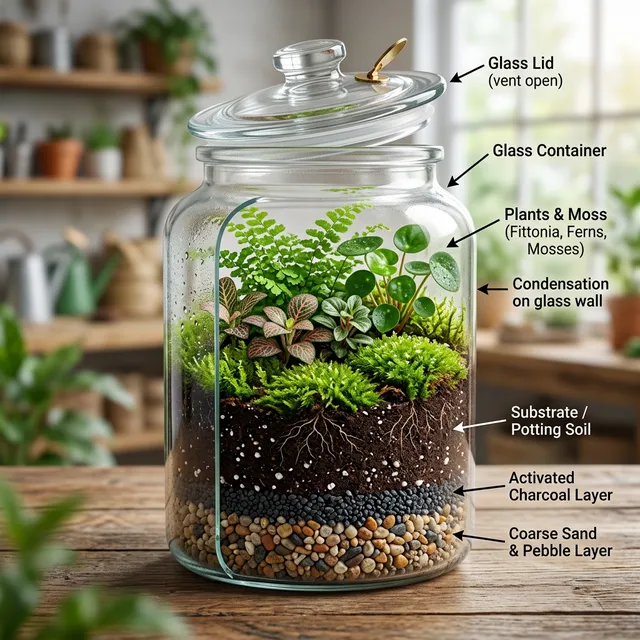
A cutaway cross-section illustration of an ideal closed terrarium setup, featuring clear layers of coarse sand at the bottom and a thin layer of black activated charcoal beneath vibrant green moss.
Decoding the Distress Signals
When you bring a plant that can’t store its own water into a bone-dry heated home, you’re fighting a massive environmental mismatch. But the good news about moss is that it doesn’t suffer in silence. The plant will tell you exactly what you are doing wrong, giving you a remarkably clear window into its environmental stresses. You just have to know how to read the visual data it provides.
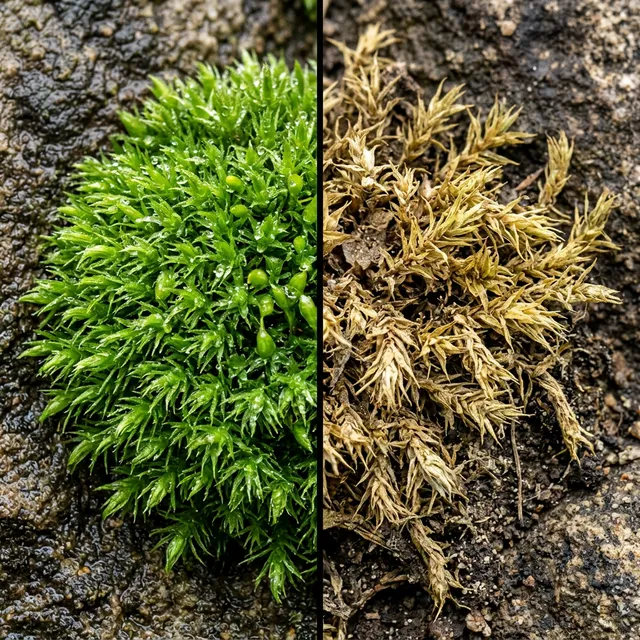
A Stark contrast: Healthy, vibrant, spongy emerald-green moss (left) compared to severely dehydrated, crunchy, and chemically burned moss (right).
“Why is my moss turning brown?”
- The Crunch Test. Is the moss feeling dramatically dry, faded, and crunchy yellow-brown to the touch? That’s severe dehydration or acute chemical burn. You either used tap water without filtering it, or the ambient humidity dropped to near zero. Radical Fix: Switch to distilled water immediately. Give the plant a heavy, direct soaking to rehydrate the cellular walls, and cover it with a glass cloche to trap the humidity.
- The Mush Test. Is the moss patch dark brown, soft, and smelling distinctly sour or swampy? You have severely overwatered it, and there is no active drainage in your vessel. The bottom layers of the moss are actively rotting due to a lack of oxygen. Radical Fix: Drain any excess standing water immediately. Check your false bottom layer. Leave the lid open to the ambient air for several days to allow significant evaporation to pull the terrarium environment back from the brink of total anaerobic collapse.
- The Ghost Test. Is the top of the moss canopy bleaching bone-white or exhibiting a very pale, generalized yellowing across the tips? Stop cooking it in direct sunlight. This is phototoxicity. Radical Fix: Physically move the terrarium further away from the window into a shaded, much cooler zone.
Mastering the Light Equation
Speaking of light: an incredibly pervasive horticultural myth insists that moss desires total, uninterrupted darkness. This misconception likely stems from seeing moss thriving only in the deep shade of old-growth forests. But make no mistake, moss remains a photosynthetic organism. Placing a moss terrarium in a windowless bathroom or a completely dark hallway corner will inevitably starve the plant to death.
The best light for indoor moss is bright, indirect window light. The ideal physical location in a home provides bright, continuous illumination without direct thermal heat. A spot situated a few feet away from an East-facing window generally offers perfect, gentle morning spectral intensity.
If you stick a sealed glass terrarium in a blazing South-facing window display, you’ve just built an active solar oven. The unshielded solar radiation will rapidly heat the enclosed glass space, evaporating all available moisture and severely scorching the delicate bryophyte leaves in a single afternoon.
If your home lacks good indirect natural light, don’t panic. Moss responds exceptionally well to a low-wattage LED grow light. It provides the full photosynthetic spectrum without generating harmful thermal heat, letting you sustain vibrant growth in even the darkest residential spaces.
Sourcing Without Stealing
Sure, it’s tempting to hike into the woods and rip a sheet of it off a rock. Don’t do that.
Wild harvesting wrecks micro-habitats and strips forests of vital infrastructure. And practically speaking, wild strains often hate the steady, stale temperatures of indoor spaces. Buy ethically grown species from terrarium nurseries—ones bred to actually survive inside a house. Give them distilled water and basic indirect light, and you’ll basically never have to buy another plant again. Which makes you wonder why everyone else makes it look so painfully hard?