Tsuboniwa: Transforming Your Balcony into a Tiny Courtyard Garden
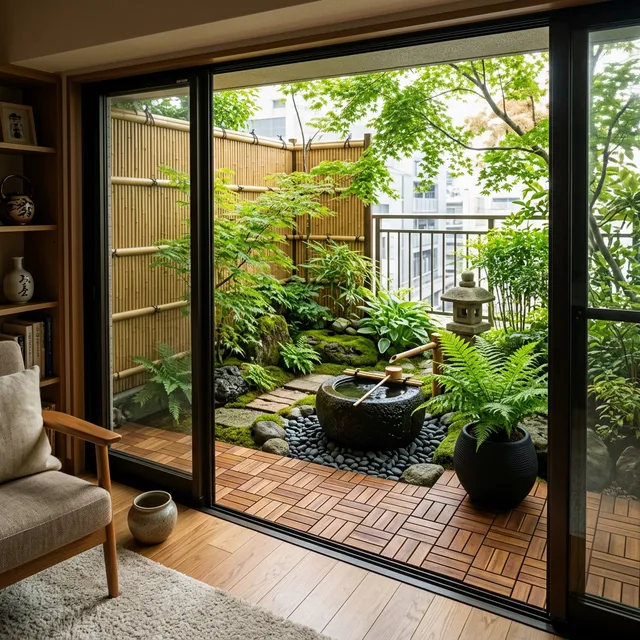
Disclosure: This post contains affiliate links. If you purchase through these links, we may earn a small commission at no additional cost to your tranquility.
Stop buying plastic IKEA furniture for your balcony. Just stop. We need to have a serious talk about that sterile 3x3 foot concrete slab hanging off the side of your apartment building. You are starved for nature, I get it. But you’re settling for absolute garbage—a cheap outdoor rug, tangled fairy lights, and a dying tropical plant you impulse-bought at a grocery store. It’s embarrassing. You are substituting genuine, natural beauty for cheap, plastic neglect.
You cannot decorate your way out of a spatial restriction. Cut to the chase. If you want a genuine connection to nature in a severely constrained urban space, you need a rigorous architectural blueprint. Not a Pinterest mood board. You need to abandon the chaotic Western approach to “balcony decor.” Look to a 1,200-year-old Japanese solution engineered specifically for tiny, dark, restricted areas.
You need a Tsuboniwa.
This is not some passing trend. This is a masterclass in spatial manipulation. The ancient architects of Kyoto figured out how to turn claustrophobia into profound Zen centuries ago. It is time you applied their blueprint to your own tiny outdoor garden layout and built a true small balcony zen garden.
The Concrete Reality of Urban Balconies
Face the architectural reality. Your modern apartment balcony is not an expansive outdoor living room. It is a functionally useless concrete box. Heavily shaded. Flanked by harsh metal or glass privacy walls. Permanently shadowed by the overhanging roof of the unit above you, acting as a brutalist concrete ceiling that traps you in the shade.
When you attempt to force standard, high-sun garden ideas into this environment? You are fighting a losing battle against physics. Biology will win. Your plants will stretch, weaken, and inevitably die. The space will feel cluttered, visually noisy, and inherently stressful.
Stop romanticizing it: people who try to cram sprawling suburban backyard concepts into a closet-sized space are completely missing the point of urban living. The energized calm of Seijaku is not achieved by hoarding mismatched terracotta pots. It is achieved through deliberate curation, aggressive subtraction, embracing understated, boring beauty, and an uncompromising commitment to minimalist design.
Tsuboniwa: The Kyoto Solution to Small Spaces
To actually solve your balcony problem, you must understand the history of the Tsuboniwa garden design.
The concept originated during the Heian Period (794–1185). The Japanese elite sought to bring fragments of the unpredictable natural world into the strict geometric confines of their sprawling shinden-style palaces. These tiny, enclosed courtyard gardens were fiercely prized for their intimate, secluded ambiance.
But the Tsuboniwa achieved absolute architectural perfection much later, within the densely packed urban core of Kyoto. Here, merchants lived in machiya—traditional wooden townhouses characterized by incredibly narrow street frontages and deeply elongated, dark interiors. To provide natural ventilation, collect rainwater, and maintain an essential connection to the changing seasons, these merchants built small, walled gardens entirely enclosed within the architecture of the home itself.
The very etymology of the word provides the blueprint for your balcony. “Niwa” means garden. “Tsubo” has a dual meaning. First, it is a traditional Japanese unit of spatial measurement (about 35.5 square feet, or the size of two tatami mats). This is almost exactly the footprint of a standard modern balcony.
Secondly—and crucially—“tsubo” translates to a vessel or a deep ceramic jar.
A Tsuboniwa is not a flat expanse. It is a three-dimensional volume. A vessel of nature contained within a built environment, capped by the floor below and the eaves above. When you start viewing your balcony not as a concrete shelf, but as a vessel—a framed, intimate canvas meant to be viewed from your adjacent living room—you gain access to some of the most profound Japanese courtyard ideas ever conceived.
Establishing the Structural Boundaries
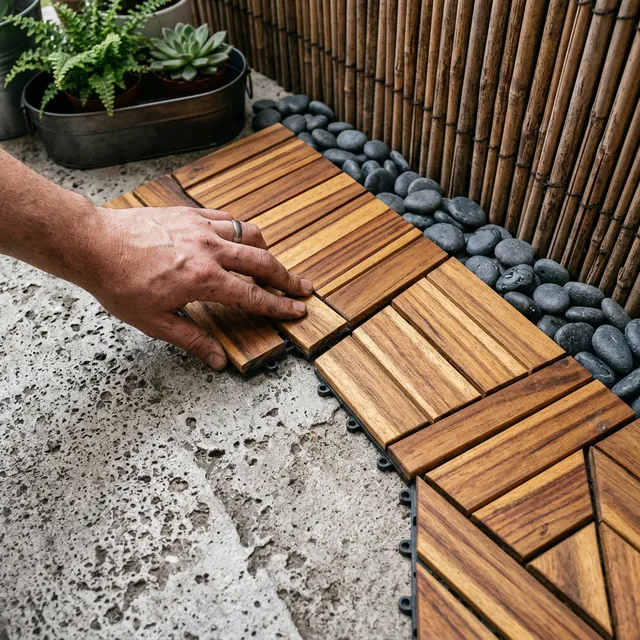
Installing interlocking engawa wood flooring tiles over a concrete balcony floor.
A true Japanese garden must feel entirely disconnected from the chaotic, noisy cityscape surrounding it. You cannot achieve peace while staring at a busy intersection through a glass railing. Why even try? Before you even think about buying a single plant, you must construct a physical foundation that completely masks your urban reality.
Step One: Cover the Concrete
The harsh, brutalist concrete of your balcony floor destroys any illusion of a natural sanctuary. You must cover it. In traditional Japanese architecture, the Tsuboniwa is typically viewed from a raised wooden veranda called an engawa.
To simulate this without violating your lease agreement, use modular engawa wood flooring tiles. These interlocking deck tiles snap directly over the concrete. They instantly add warmth and organic texture to the space.
| Flooring Material | Characteristics & Maintenance | Ideal For |
|---|---|---|
| Acacia Wood | ~$80 to cover a standard 3x3 foot balcony. Warm aesthetic but requires roughly 1 hour of manual oiling every spring to prevent splintering. | Renters on a strict budget seeking immediate transformation. |
| FSC Teak | ~$150+ to cover a standard 3x3 foot balcony. Premium, heavy-duty durability. Weathers beautifully over time. | Long-term installations embracing the spirit of Wabi-Sabi. |
Step Two: Erase the Periphery
Next, you must aggressively manage the vertical space. Modern metal or glass balcony railings immediately shatter the illusion of a secluded courtyard. You need to erect a barrier.
Unroll a tightly woven bamboo privacy screen along your existing railing. Secure it strictly every 12 inches using UV-resistant, outdoor-rated zip ties to ensure it survives high-altitude wind shear. This acts as a modern, outdoor folding screen. This masks the ugly modern architecture, blocks the wind, and creates the intimate, deeply enclosed feeling of a traditional Kyoto merchant home. You are not building a view of the city. You are building a refuge from it—a personal sanctuary at the end of your daily commute.
Mastering Minimalism: Stones and Basins
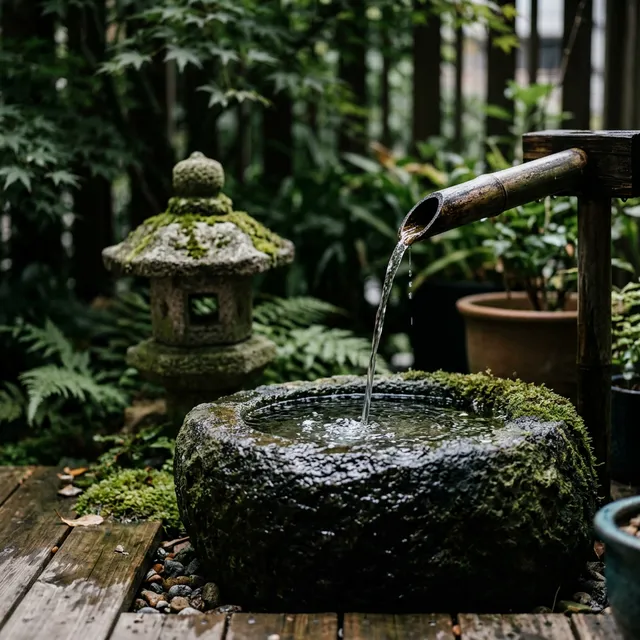
A traditional Tsukubai stone basin serves as the visual anchor in a Karesansui dry landscape.
Once your structural boundaries are set, you must practice extreme restraint. The ancient rules of Karesansui dry landscape design dictate that empty space (Ma) is just as important as the objects within it.
Do not fill your new wooden floor with a dozen small, competing planters. You are not running a nursery. You need one singular, undeniably strong focal point that commands the space. In a Tsuboniwa, this is almost always the water basin.
The Tsukubai
The Tsukubai is a carved stone basin. Traditionally, it was used for temizu (ritual handwashing) before entering a tea ceremony. In your balcony garden, it serves as the absolute visual anchor.
Do not underestimate the psychological power of moving water. A traditional bamboo shishi-odoshi (water spout) pouring a continuous, crystalline stream into a dark stone basin acts as a powerful acoustic mask. It replaces the abrasive sounds of urban traffic with steady, meditative white noise.
When evaluating a Tsukubai stone basin price, understand that you are investing in the core architecture of the garden—not a disposable decoration. Keep in mind the physical reality: hauling a 110 lb granite slab up a narrow apartment stairwell is no joke, but the acoustic density it provides is worth the sweat.
- Budget Tier ($100 - $200): Faux-stone resin or basic clay pot fountains. They work acoustically but lack the authentic weight of real stone.
- Mid-Tier ($200 - $400): Reproduction basalt basins. Excellent weight and authentic texture.
- Premium Tier ($600+): Authentic, imported Japanese granite or antique stone. Generational pieces of art.
Position the basin in the center or a dominant corner, resting it on a meticulously raked bed of dark river stones. If space permits, pair it with a small, moss-flecked stone lantern (Ishi Doro) to provide dramatic, low-voltage shadow lighting against your bamboo screens at night.
The Botanical Strategy for Deep Shade

A curated arrangement of shade-tolerant balcony plants including Japanese ferns, Hostas, and Boxwood.
This is where almost everyone fails. They buy high-sun Mediterranean plants for a deeply shaded urban balcony and then wonder why everything dies.
Stop deluding yourself: your balcony is functionally a cave. The opaque railings and the concrete overhand from the unit above mimic the deep, restrictive shade found in the walled courtyards of ancient Kyoto. A defining characteristic of the historical Tsuboniwa was its profound lack of direct sunlight. The flora must be specifically chosen to thrive in komorebi—dappled, indirect light.
Traditional guidelines explicitly recommend limiting your botanical palette to merely one to three symbolic plants. This prevents the tiny vessel from feeling visually suffocating.
You must select highly specific, shade tolerant balcony plants. Here is the exact, pragmatic botanical strategy for your urban Tsuboniwa:
| Botanical Species | Aesthetic Function in the Tsuboniwa | Light & Maintenance Reality |
|---|---|---|
| Japanese Ferns | Provides delicate, feathery texture. Perfectly mimics the ancient, damp moss gardens of Kyoto. | Full to Part Shade. Requires strict attention to moisture retention. Do not let them dry out. |
| Hostas (e.g., ‘Autumn Frost’) | Broad, geometric foliage. Requires a minimum 14-inch diameter container to accommodate root mass. Provides immense structural contrast against the fine, linear texture of bamboo screens. | Partial to Deep Shade. Highly durable in enclosed pots and tolerant of varying soil conditions. |
| Boxwood (e.g., Buxus macrophylla) | Evergreen structure. Can be meticulously sheared into formal, spherical shapes (Karikomi) to represent rolling hills. | Sun to Full Shade. Perfect as a structural anchor next to the stone basin. |
| Coleus / Begonias | Introduces deep, dark, moody organic color. Doesn’t rely on high-sun floral blooms. | Part Shade. Excellent, low-maintenance fillers that provide instant visual impact. |
Crucial Note on Container Hydration: When gardening in deep shade, the rules of watering change entirely. Shade plants require significantly less water than those baking in full sun. However, they demand absolute perfection in drainage. Ensure your ceramic pots have a minimum 1-inch drainage hole and are elevated at least 1 inch off the deck tiles. Utilize a high-porosity soil matrix (e.g., 50% pine bark fines, 30% pumice, 20% compost) to guarantee rapid water evacuation and prevent fatal root rot. Water heavily. Water infrequently.
You do not need a sprawling suburban estate to find peace. By applying the ruthless minimalism, historical architecture, and specific shade horticulture of the Kyoto Tsuboniwa, you can transform a miserable 3x3 concrete slab into a profound, living sanctuary. Is it work? Yes. But what is the alternative? Another dead plastic fern and a string of broken lights? Stop decorating. Start curating.