Vertical Zen: Creating a Framed Moss Wall for Your Home Office
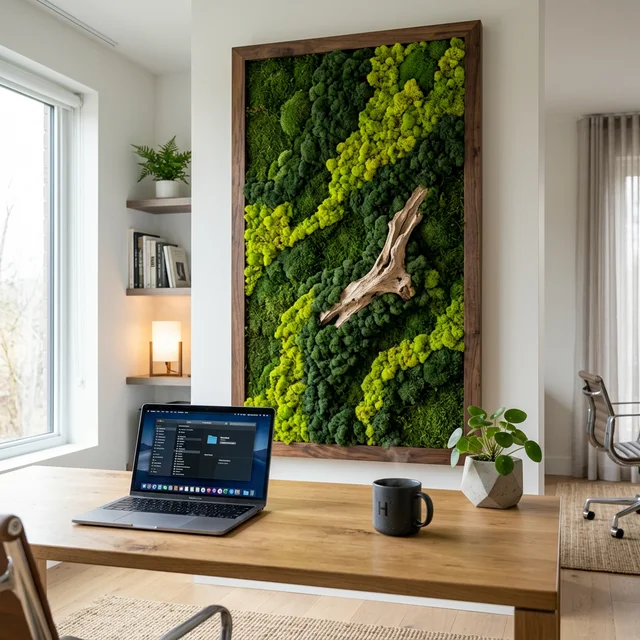
The Neuro-Aesthetic Crisis of the Modern Office
Are you currently looking at a blank wall or a cheap, mass-produced frame you bought at Target? Throw it away.
MDF. Drywall. Synthetic carpet. You are not working in an office; you are working in a sensory deprivation chamber. Minimalist cool gray? Total failure. It starves your eyes of texture and pummels your ears with acoustic reflections. This breeds what we call Open World Fatigue.
And no, the antidote is not another plastic succulent from a corporate “mindfulness” kit. Listen to me: you need deliberate biophilic office decor. You need Seijaku (energized calm)—reducing visual noise to create profound stillness.
We are going to build a framed, preserved moss wall. A massive, multi-sensory anchor. It’s sound absorbing wall art that mimics nature’s structural complexity, gently engaging your brain’s capacity for “soft fascination.” This lowers prefrontal cortex activity. It aggressively reduces occupational burnout.
The best part? We do it without bringing a single drop of water indoors.
The Foundation: Preserved vs. Living Moss
Stop trying to force an indoor rainforest into an apartment. It’s madness. Let us address the most common, maddening delusion in the DIY space: the pursuit of a vertical garden indoor using living moss. Here is the cynical truth regarding a living vs preserved moss wall:
| The Delusion (Living Moss) | The Zen Solution (Preserved Moss) |
|---|---|
| Atmosphere: Requires a humid, greenhouse-level environment that ruins drywall. | Atmosphere: Thrives in standard 40% - 60% indoor humidity levels. Zero rot. |
| Infrastructure: Demands complex drip-irrigation plumbing and full-spectrum LED lighting. | Infrastructure: Completely inert. Requires zero water, misting, or specialized light. |
| Maintenance: A biological organism needing continuous pruning. | Maintenance: Mono no aware realized. Endures 7-10 years untouched. |
| Cost: $185-$240+ per square foot to install properly without rot. | Cost: High visual impact without the massive architectural sabotage. |
If you want a truly pragmatic, renter friendly vertical garden, you must rely entirely on preserved moss.
The Science of Preservation
Do not confuse “preserved” with “artificial.” Preserved moss is 100% real, sustainably harvested flora that has undergone rigorous chemical stabilization. The natural sap within the plant’s cellular structure is entirely extracted and replaced with food-grade glycerol (a non-toxic polyol compound) and structural dyes.
This renders the plant biologically inert. It is frozen in time.
- Zero Watering: Literally none.
- Zero Light Requirements: In fact, keep it out of direct UV light—otherwise the dyes fade.
- Zero Maintenance: It asks absolutely nothing of you. You hang it. You ignore it. It performs.
When you understand the principles of indoor moss care, you realize that fighting the physics of an HVAC system is a fool’s errand. Preserved moss offers the profound beauty of Shizen (naturalness) without the burden of constant life-support. It typically lasts seven to ten years if left undisturbed.
The Scientific USP: Acoustic Dampening and Thermodynamic Transfer
We are not just hot-gluing green fluff to a board. We are engineering a functional architectural treatment.
The Physics of Indoor Reverberation and the Remote Work Crisis
The modern home office relies on hard, flat surfaces (glass, wood, drywall) that are highly acoustically reflective. Sound waves—specifically the mid-to-high frequencies from your video calls—strike these surfaces and bounce back. Overlapping echoes. Severe auditory fatigue.
Traditional foam panels solve this, but they look like a recording studio threw up on your wall. Preserved moss accomplishes the exact same goal through the physics of thermodynamic transfer.
The Mechanism of Moss Sound Absorption
When airborne sound energy penetrates the highly porous, fibrous structure of a moss installation, the acoustic waves cause those microscopic fibers to vibrate. This friction converts sound energy into heat. Deadening the echo. Completely.
Empirical Performance: Quantifying NRC Ratings
Crucial Note: This is not anecdotal. Empirical laboratory testing (under ISO 11654:1997 and ASTM C423 standards) demonstrates that standard reindeer moss panels achieve a Noise Reduction Coefficient (NRC) of 0.55 to 0.70. This means they absorb up to 70% of the ambient sound energy they encounter. Denser installations utilizing domed “bun moss” can achieve an NRC of 0.90, matching professional acoustic fiberglass. (Source for acoustic testing data)
By building this DIY moss wall art, you are actively engineering your room’s acoustics. If you are serious about optimizing your environment’s auditory profile, you must understand the larger framework of sonic sanctuary design in 2026.
Engineering the Substrate: Frame Construction and Reinforcement
The internet is littered with preserved moss wall tutorials produced by amateur craft blogs that fundamentally fail at structural engineering. They tell you to buy a cheap, mass-produced picture frame and glue the moss directly to the 3/16-inch cardboard backing.
Do not do this. It is a structural disaster.
Cardboard lacks the tensile strength to support pounds of moss and heavy adhesives. Worse, when subjected to the extreme thermal heat of fifty sticks of hot glue, the cardboard will warp, pulling away from the frame and ruining the flush mount against your wall. If you are building a deep shadowbox, filling the void with cardboard is a fast way to consume massive amounts of expensive glue just to build a false bottom.
The Professional Neoprene Upgrade
To execute this correctly, approach the frame like an architect.
- Reinforcement: Building a frame larger than 18” x 24”? Cut 2” x 2” squares of scrap plywood. Drill pilot holes and screw them into the back corners of the wooden frame so it doesn’t rack over time.
- The 1/4-Inch Neoprene Solution: Discard the cardboard. Toss it. Replace it with a sheet of 1/4-inch thick, high-density black neoprene foam (often sold with a peel-and-stick backing).
Neoprene foam is structurally rigid, light enough for heavy-duty Command strips, and provides an optimal bonding surface. Most importantly, it reduces hot glue absorption by over 60%. It saves you money. It prevents the entire piece from becoming a heavy, warped mess of dried plastic.

The complete bill of materials: preserved reindeer moss, sheet moss, mood moss, a professional hot glue gun, 1/4-inch neoprene foam, and precision tools laid out on a walnut workbench.
Material Sourcing: The Anatomy of the Forest
You are building a micro-environment. A uniform wall constructed from a single species of moss looks flat, artificial, and cheap. To achieve a premium, gallery-tier aesthetic, you must source a variety of botanical morphologies. This is where you practice Shibui—understated, complex beauty that doesn’t rely on screaming neon colors.
| Botanical Material | Purpose & Texture |
|---|---|
| Sheet Moss (Hypnum) | Flat, low-profile foundation. Covers the neoprene base quickly. |
| Reindeer Moss (Cladonia rangiferina) | Spongy, 3D lichen. Takes structural dye beautifully. |
| Mood Moss (Dicranum scoparium) | Dense undulating mounds. Creates deep shadows and visual anchors. |
| Hardscaping (Driftwood, Bark) | Rigid elements to break up green monotony and provide visual resting points. |
Pro Tip for Sourcing: Do not buy your moss at a local big-box craft store; the quality is universally atrocious. Source your preserved moss in bulk from specialized botanical suppliers or reputable artisans. Ensure you are buying high-quality, sustainably harvested moss treated with glycerol, not cheap, brittle material spray-painted green.
The Mechanics of Adhesion: Thermodynamics and Application
The method used to attach the moss dictates the longevity and safety of the final piece. While mechanical attachment (floral wire or pins) works for sculptural 3D forms, thermal adhesion (hot glue) is the definitive, pragmatic recommendation for a flat wooden frame. Because the moss is biologically inert, the thermal shock of molten industrial glue will not damage the plant. It creates an unbreakable bond.
However, applying hot glue to porous moss presents a severe burn risk. The glue will pass completely through the fibers of reindeer moss and instantly sear your skin.
The Paintbrush Protocol
You must execute the following safety protocol:
- Prep the Anchor: Apply a thick bead of hot glue directly to the neoprene substrate (never to the moss).
- Placement: Quickly place the root-end of the moss tuft onto the hot glue.
- The Press: Do not use your fingers. Immediately use the blunt, wooden handle of a small paintbrush (or a wooden dowel) to firmly press the moss deep into the molten adhesive. Hold it for five seconds until the glue cures.
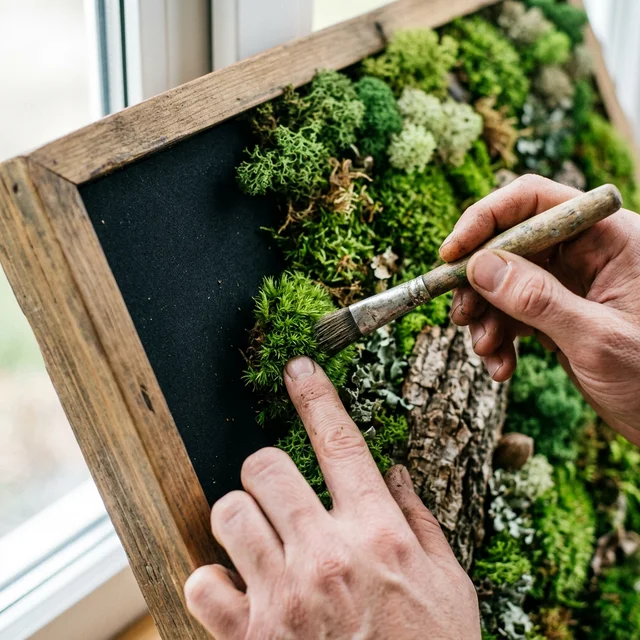
The paintbrush protocol in action: using a wooden dowel to safely press reindeer moss into hot glue on a neoprene substrate, preventing severe burns.
The Mandatory “Shake Test”
A true Zen practitioner embraces Wabi-Sabi—the beauty of imperfection—but structural failure is not an imperfection; it is negligence.
Once your frame is entirely filled and the glue has fully cured (wait at least two hours), you must perform the Shake Test. Here is the process:
- Invert: Flip the heavy frame over a drop cloth.
- Agitate: Firmly shake the entire structure.
- Clear Debris: It releases loose woodland debris (pine needles, dirt clods) that were trapped in the moss.
- Identify Failures: It reveals unattached moss clumps that require secondary gluing.
- Final Polish: It exposes unsightly strings of dried hot glue, which you must meticulously remove with metal tweezers to guarantee a pristine, professional finish.
Biomorphic Pattern Design and Textural Mapping
When you begin gluing, you are no longer a carpenter; you are an artist painting with texture.
Do not create geometric grids. Do not create perfect checkerboards. Do not make symmetrical stripes of light and dark green. Nature does not operate in right angles or perfect symmetry. You must embrace biomimicry by designing flowing, asymmetrical shapes that replicate natural geography.
Start by placing your structural hardscaping—a heavy piece of sandblasted driftwood or rugged Poplar bark—off-center. Treat this as your primary anchor.
Next, establish a “river.” Take chunks of vibrant, bright-green Reindeer moss, tear them into smaller, irregular pieces, and glue them in a winding, meandering path that travels diagonally across the frame.
Finally, build the “banks” of the river using your darker, denser Mood moss and fill the remaining negative space with the flat, foundational Sheet moss. The transition between these textures should be organic and slightly chaotic, forcing the eye to explore the depth of the frame rather than tracing a predictable geometric line. This chaotic harmony is what reducing visual noise actually looks like in practice; it is complexity organized by natural law.
The relentless desire to keep indoor things alive has turned our living spaces into obligations. We force tropical plants into arid apartments and punish ourselves when they inevitably rot. It is exhausting. And it completely ruins the point of a restorative environment.
By constructing a preserved moss wall, you bypass the labor without sacrificing the aesthetic. You deploy the profound, sound dampening utility of biophilic design. You honor the concept of Mono no aware—an appreciation for the deep, fleeting beauty of the natural world—without the desperate, anxious need to artificially extend its lifespan.
Hang your frame. Anchor it securely to your drywall. Walk away. And then, for the next ten years, do exactly what the moss is doing: be still.
For further integration of these principles, explore how Wabi-Sabi can radically alter your perception of impermanence, or how to properly organize the rest of your desk using negative space principles.